
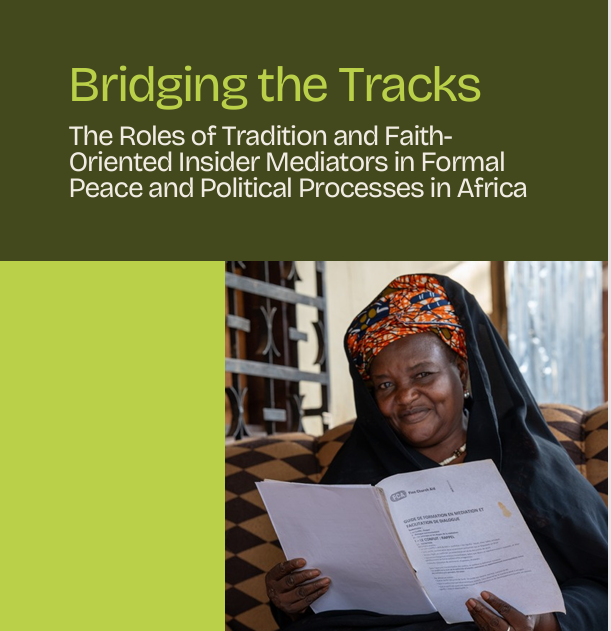
Tradition-and Faith-Oriented Insider Mediators (TFIMs) play vital yet under-examined roles in formal peace and political processes across Africa. Rooted in religious or traditional authority and embedded in their communities, they are among the first to sense rising tensions, the most trusted to intervene, and the last to disengage during crises.
While their contributions to local-level conflict resolution are widely recognized, their engagement in formal, high-level arenas such as peace negotiations, national dialogues, and constitutional reforms remains poorly understood, inconsistently supported, and structurally sidelined. This report sees that as a gap worth addressing.
TFIMs are uniquely positioned as cross-track brokers, with relationships that span both grassroots communities and high-level political spaces. Their ability to move between these tracks and to integrate the spiritual, moral, and political dimensions of dialogue and reconciliation makes them well-placed to enrich the design and delivery of formal peace and political processes. Drawing on more than 40 interviews and case studies from Ethiopia, Mozambique, Kenya, South Sudan, Nigeria, Cameroon, Somalia, and the Central African Republic (CAR), this report applies a political economy lens to examine how power, legitimacy, and institutional design shape the roles of TFIMs in peace and political processes: how they are included, on what terms, and with what influence. The report addresses three core research questions:
1.What roles do TFIMs play in formal peace and political process, and what makes their contributions distinctive?
2.What barriers constrain their meaningful inclusion, and how are these shaped by political, institutional, and normative dynamics?
3.What enabling conditions could support TFIMs to participate safely, strategically, and sustainably